



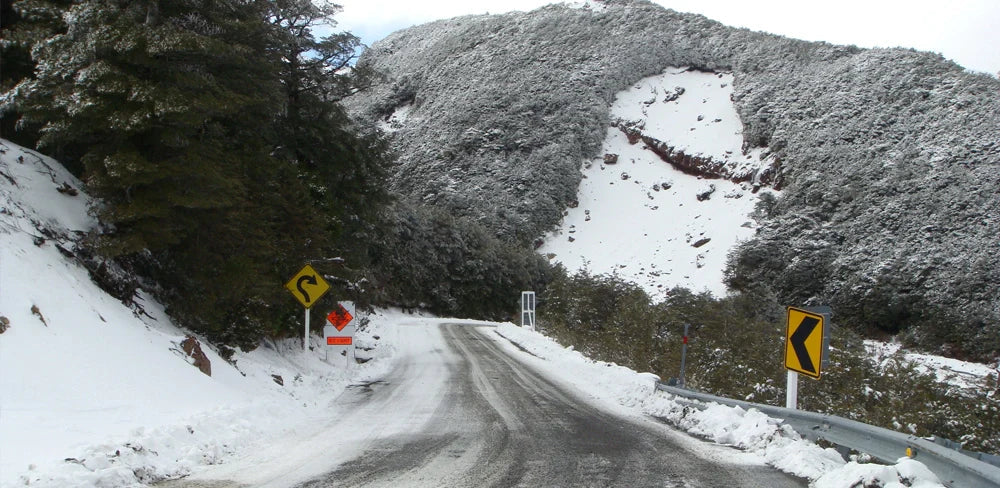
Icy winter roads can catch anyone out. Pretty much every Wanaka or Queenstown local has a cautionary tale about unexpectedly hitting ice on the Lindis Pass, Crown Range or Cardrona Valley Road and ending up in the ditch. And that’s even before you get to the ski field access roads. The good news is that if you’re careful and know what you’re doing, you shouldn’t have a problem.
How To Drive Safely on Snow and Ice
Tips For Safe Ski Field Driving in New Zealand
This article is for everyone who is coming down to the South Island and plans to drive themselves to the mountains for skiing or snowboarding. We’re going to share the benefit of decades of experience of winter driving at Outside Sports, so you can stay safe on the road when you’re heading to the snow.
Just. Slow. Down. A. Bit
They say the faster you’re going, the bigger the mess. Without getting into the physics of it, the faster you’re going the less your car wants to change direction – which is a problem if the road is icy and your tyres have low traction. And don't be fooled AWD or 4WD doesn’t help when your car turns into a sled on an icy corner. On the other hand, decreasing your speed does help. It reduces your momentum and makes it easier for your tyres to maintain grip and ability to steer the car. If the open road limit is 100km/h don’t be embarrassed to drive at 30km/h or less in icy conditions. Just flick on your hazard lights and let impatient drivers go past if they are happy to risk it. Driving cautiously is less embarrassing than having a crash.
Snow Tyres Are Not a Thing in New Zealand!!
No vehicles in NZ are fitted with they type of snow tyres that you might commonly find in Japan, North America, or Europe. We only have all-season tyres here. Even the chunky tyres on SUVs aren't snow tyres, they're off road tyres, and are completely different things. Snow tyres have special treads designed to trap snow, but they are not suitable for normal NZ roads at any time of year - and are in fact very dangerous in rainy weather as they have very low grip on wet sealed surfaces.
Take Your Time
Leaving for the ski fields half an hour earlier earlier and driving slower will go a long way to reducing the risk of skidding on icy roads. You might also get a better car park! If you need to hire snow gear like skis or snowboards you can save time in the morning but hiring from Outside Sports in Queenstown or Wanaka the night before you go to the mountain.
*555 - Police Alert Phone Number
If you see someone driving dangerously on any New Zealand road, regardless of the weather call *555 on your mobile phone and report it to the Police. You might save someone’s life.
How to Drive on Black Ice
Black Ice is a film of clear frozen water on the road surface, and it’s invisible! It can be present on any road when the air temp is below freezing – and in shady parts of the Cardrona Valley that can be all day long – but it’s usually worst early in the morning and at night. If your car outside air temperature gauge is saying 3° or below, you need to be careful because the road could be icy.
How to drive on White Ice
You can see white ice on the road so that should be a big clue that you need to slow down and drive with extreme caution.
AWD and 4WD Vehicles Are Not Magic
Four-wheel drive is great for maintaining traction when you’re driving forwards on low-grip surfaces. But they don’t increase a car's lateral grip and will not help you if you’re sliding sideways on ice because you've been going too fast. You still need to slow down when you’re driving an AWD or 4WD vehicle.
How Fast Is Too Fast?
Apart from the signposted legal speed limit you speed should be dictated by the conditions and the grip your vehicle has on the road. In extreme conditions on a steep and narrow mountain access road where ice and snow combine with fog you might find that the appropriate speed is 10km/h.
What to Do If You Lose Control in a Skid?
There are two main things to remember: 1. Take your feet off the pedals (don’t brake or accelerate). 2. Look at where you want the car to go, NOT at what you want to avoid hitting.
The slower you’re going, the quicker your car will give you back control of the steering – but wait until you come to a complete stop before you try to carry on again.
Gentle Inputs
In gentle when you’re driving in low grip conditions like ice, mud or gravel you must try to keep all your steering and pedal inputs to a minimum to avoid losing traction or to avoid making things worse in a skid. So don’t jerk the steering wheel, slam on the brakes, or mash the accelerator.
You Don't Have to be Scared of Snow Chains
The very thought of having to put on snow chains is enough to keep some people at home. But chains are all part of driving yourself to the mountains. They can sometimes be required on the Crown Range Road and Lindis Pass, but usually you won’t need them until you get to the ski field after a recent snowfall or there’s been a heavy frost.
Often you’ll see a sign somewhere that says ‘Chains on 2WD’ which means that if your car is driven by the front or rear wheels only, then you need to fit chains to the drive wheels to have sufficient traction to get up the road safely.
AWD cars and 4WD SUVs can sometimes avoid chains because their linear extra traction means they can claw their way up through snow or mud (it’s usually both). However, if the road is icy then the signs will say ‘Chains on all vehicles.’ Don’t ever imagine that doesn’t apply to you even if you're in a $150K Landcruiser. When you get stuck or have an accident if you should have had chains on, you will get no sympathy from anyone.
How to Fit Chains to Your Vehicle
Step 1. Practice at Home
The first time you fit chains should not be at the side of the road in the ice and snow. Even if you’re renting a vehicle it’s smart to practice in the carpark of your accommodation. If you follow the instructions, most chains only take a couple of minutes to put on.
Step 2. Put Your Chains On Early
When you see a ‘Chains required sign’ stop and fit them at the first safe stopping place. On all ski field roads there are ‘Chain bays’ for that exact purpose. Don’t be tempted to go a bit further to the next chain bay – you might not make it.
Step 3. Expect to Get Dirty
Fitting chains means kneeling on the road, which is often muddy. Experienced mountain drivers often have a foam pad or maybe a ground sheet to kneel on, and an old coat to put on over the top to protect their nice snow clothes.
Many people also have tough work gloves in the car to wear when they're fitting chains to avoid the bumps and cuts it's easy to get when you're handling cold in very cold conditions.
Taking chains off is usually even muddier as you have to reach around behind the tire to undo the inside link. The less clearance there is between the tyre and wheel arch the worse it is. It’s not uncommon to end up lying down and peering under the car to get at the rear link. You’ll be really glad of that old jacket or ground sheet then. 😁
A hack to remember is that the chain connector behind the tyre is always directly opposite the hook on the front – that'll help you avoid groping blindly to find it. If your car doesn’t have much clearance between the tyre and the wheel arch, you might find it’s a bit easier to undo the rear connector if it’s positioned at the lower front of the tyre with the wheel turned outwards. You might have to move the car slightly backwards or forwards to position it there.
Safe Winter Driving Tips in Summary
- Be aware of the road surface conditions each day
- Slow down and expect ice if the temperature is below 3 degrees
- Drive gently - don't make any harsh or sudden movements of the pedals or steering wheel.
- Always carry tyre chains and practice fitting them to your vehicle - before you need them