



If you've ever booked a service and been asked whether you want a hand tune or a machine tune, you might have picked one without really knowing the difference. It's a question worth understanding, because the answer affects edge performance in ways that matter more to some skiers and riders than others. Here's what each involves, where each one excels, and how to decide which is right for you.
Hand Tune vs Machine Tune: What's Better for Ski and Snowboard Edge Performance?
What Is a Machine Tune?
A machine tune uses an automated edge grinding system to sharpen and bevel both the base edge and side edge of your ski or snowboard. The ski passes through the machine at a set angle, and a grinding wheel removes metal from the edge to restore sharpness and set the bevel.
Machine tuning is fast, consistent, and accurate at setting bevel angles. The same angle is applied along the full length of the edge without variation, which is an advantage for recreational skiers who want reliable, predictable edge performance across the whole ski. Most workshop full-service packages use a machine tune as the primary edge work, often followed by a hand finishing pass.
The limitation of a machine tune is that it removes more metal per pass than hand tuning, and it applies the same treatment to the entire edge regardless of condition. Areas that were already in good shape get ground the same as areas that were damaged or dull. Over time, repeated machine tuning removes more edge material than necessary.
What Is a Hand Tune?
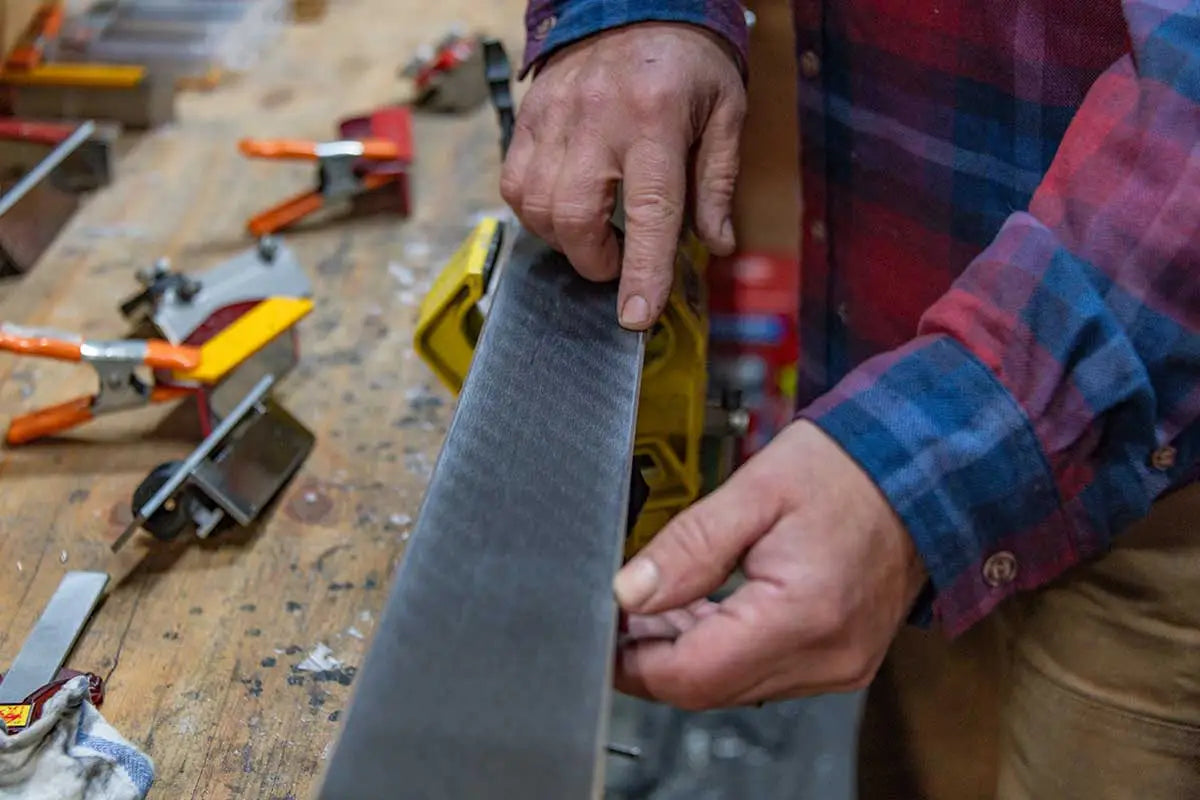
A hand tune is done entirely by a technician using files and stones. A flat file is used to sharpen and set the side edge bevel, and a base edge file guide is used to set the base edge bevel. The technician works along the full length of the edge, feeling for burrs, inconsistencies, and damage as they go, and addressing each section individually.
Because a hand tune is done by feel as much as by measurement, it allows a skilled technician to treat different sections of the edge differently. The tip and tail of a ski, for example, are often slightly detuned (softened) to prevent catching on entry and exit of turns, while the contact points underfoot are kept sharp for maximum grip. A machine can't make that distinction. A hand tune can.
Technically, a hand tune also removes less metal per session than a machine tune. For skiers and riders who want to preserve their edges over the long life of their gear, regular hand tuning between machine services makes sense.
Where Each One Excels
Machine tuning is best for restoring edges that are significantly dull, damaged, or inconsistent. After a season's use, a rock strike, or any situation where the edge geometry needs to be reset from scratch, a machine does the job efficiently and accurately. It's also the more cost-effective option for recreational skiers who want reliable performance without the time investment of a full hand tune.
Hand tuning is best for maintaining edges that are already in reasonable condition, fine-tuning bevel angles for specific skiing styles or snow conditions, and for performance-oriented skiers and riders who want precise, customised edge work. Racers and advanced skiers often prefer hand tuning for this reason, as small adjustments to bevel angle can meaningfully affect how a ski performs on firm NZ snow.
For snowboarders, hand tuning is particularly valuable for managing the tip and tail edges, which on a twin-tip board need to be detuned symmetrically to prevent catching when riding switch. A machine applies the same bevel along the full edge, which isn't always ideal for freestyle or all-mountain riders.
The Case for Combining Both
The most common approach at a good workshop is to use both. A machine tune resets the edge geometry and removes significant damage efficiently, followed by a hand finishing pass to refine the edge, address any sections the machine didn't fully resolve, and detune the tip and tail where appropriate. This combination gives you the efficiency and accuracy of machine work with the precision and customisation of hand finishing.
If you're booking a full service and edge performance matters to you, it's worth asking whether the service includes a hand finishing pass after the machine tune, or whether it's machine only.
Bevel Angles: Why They Matter
Whichever method is used, the bevel angles set during the tune are what actually determine how your ski or snowboard performs on snow. There are two angles to understand:
The base edge bevel is the angle ground into the base side of the edge. It determines how much the edge engages when the ski is sitting flat on the snow. Most recreational skiers run 0.5 to 1 degree, which gives a slight release and prevents the edge from catching on flat terrain. Racers often run 0.5 degrees or less for maximum contact and grip.
The side edge bevel is the angle ground into the side of the edge. It determines how aggressively the edge bites when the ski is tipped onto its edge in a turn. All-mountain skiers typically run 1 to 2 degrees. More aggressive skiers and racers often go to 2 to 3 degrees for a sharper, more responsive edge feel on hard snow.
Getting these angles set correctly for your skiing style and the conditions you typically encounter in the Southern Lakes makes a bigger difference to on-snow feel than most recreational skiers expect. For a broader understanding of what edge work fits into a full service, our guide to ski tune vs wax vs full service is a good starting point.
What's Right for You?
For most recreational skiers and snowboarders getting out 10 to 20 days a season, a machine tune as part of a full service at the start of the season, with a hand touch-up mid-season if edges start to go, is a practical and cost-effective approach.
For skiers and riders who are on the hill frequently, skiing hard pack and ice regularly, or who are particular about how their edges feel, a hand tune or a machine tune with hand finishing is worth the additional time and cost. In NZ conditions, where firm groomed snow is common at resorts like Coronet Peak and the lower mountain at Treble Cone, sharp and correctly bevelled edges make a real difference to confidence and control.
If you've had a rock strike or significant edge damage, start with a machine tune to reset the geometry before moving to hand maintenance. Our guide on signs your skis or snowboard need a tune will help you work out how much attention your edges currently need, and our breakdown of how often to service your gear in NZ conditions covers when to schedule each type of service.
For a hand tune, machine tune, or full service in Queenstown or Wānaka, you can book your gear in with our snow workshop and we'll recommend the right approach for your gear and how you ski. For an idea of pricing, see our guide to ski servicing costs in Queenstown and Wanaka.