Free shipping on orders over $150 T&Cs Apply

60-Day Hassle-Free Returns

You don't need a boot built from scratch to ski in something that feels completely personal to your foot. Here's what custom ski boots really means — and how the process works.

There's a moment most skiers know well. You set off on a crisp morning, the mountain is looking perfect, and within a couple of runs the foot pain starts. Pressure on the side of your foot. Toes going numb. A hot spot on your heel that wasn't there yesterday. By lunchtime you're loosening buckles and counting down to après.

It doesn't have to be this way. And the solution isn't to simply buy a bigger boot or wear thicker socks. The solution is a custom ski boot fit — and it's more accessible, and more transformative, than most skiers realise.

What Is a Custom Ski Boot?

Let's clear up a common misconception straight away. A custom ski boot is not a boot built entirely from scratch using a mould of your foot. That level of customisation exists, but it's largely the domain of elite racers and professional athletes with highly specific performance requirements and the budget to match.

For the vast majority of skiers, a custom ski boot means something far more achievable: a standard production boot that has been comprehensively modified and personalised by a professional boot fitter to work with the unique characteristics of your feet.

The goal is the same — a boot that fits as if it were made for you — but the process starts with an existing boot and transforms it through a series of targeted, expert adjustments. The result is something that feels entirely personal, because in every meaningful way, it now is.

Why Standard Ski Boots Fall Short

Standard ski boots are engineered to fit as many feet as possible. They're built to average dimensions — average length, average width, average volume, average arch. And while modern ski boot manufacturing is impressively sophisticated, the simple truth is that no two feet are the same.

Foot length, width, arch height, instep volume, heel shape, calf size, ankle position — every one of these dimensions varies from person to person, and often between a skier's left and right foot. When you put a uniquely shaped foot into a generically shaped boot, something has to give. Usually it's your comfort, your control, or both.

The consequences go beyond discomfort. A boot that doesn't fit correctly forces your foot into a compromised position, which affects your balance, your power transfer, and your ability to ski efficiently. Muscle fatigue sets in faster as your body compensates for the misalignment. Cold feet and numbness follow restricted circulation. Pressure points turn into blisters, black toenails, and the kind of pain that cuts ski days short.

None of this is an inevitable part of skiing. It's all the result of a boot that hasn't been fitted properly.

Custom vs Standard Ski Boots: What Actually Changes

When a boot fitter works on your boots, the differences between a standard and a custom fit are significant across every dimension that matters:

Interior volume — Standard boots have a fixed, generic volume. A customised boot has its volume adjusted precisely to your foot, eliminating dead space and pressure in equal measure.

Comfort — Standard boots create uneven pressure distribution that leads to hot spots and pain. A custom fit distributes pressure evenly across your entire foot for lasting, all-day comfort.

Energy transfer — A standard boot that doesn't hold your foot correctly loses energy in the gaps between foot and boot. A properly fitted boot transmits every movement directly and efficiently into your skis.

Stability — Standard boots offer variable stability depending on how well they happen to fit. A customised boot gives you a consistently balanced, stable platform that supports correct posture throughout the day.

Fatigue — In a standard boot, your muscles work harder to compensate for poor positioning and instability. A custom fit reduces this compensation, meaning less fatigue and more runs.

The Custom Ski Boot Fitting Process — Step by Step

Transforming a standard boot into a custom one is a precise, methodical process. Here's how our expert boot fitters approach it:

Step 1: Complete foot analysis

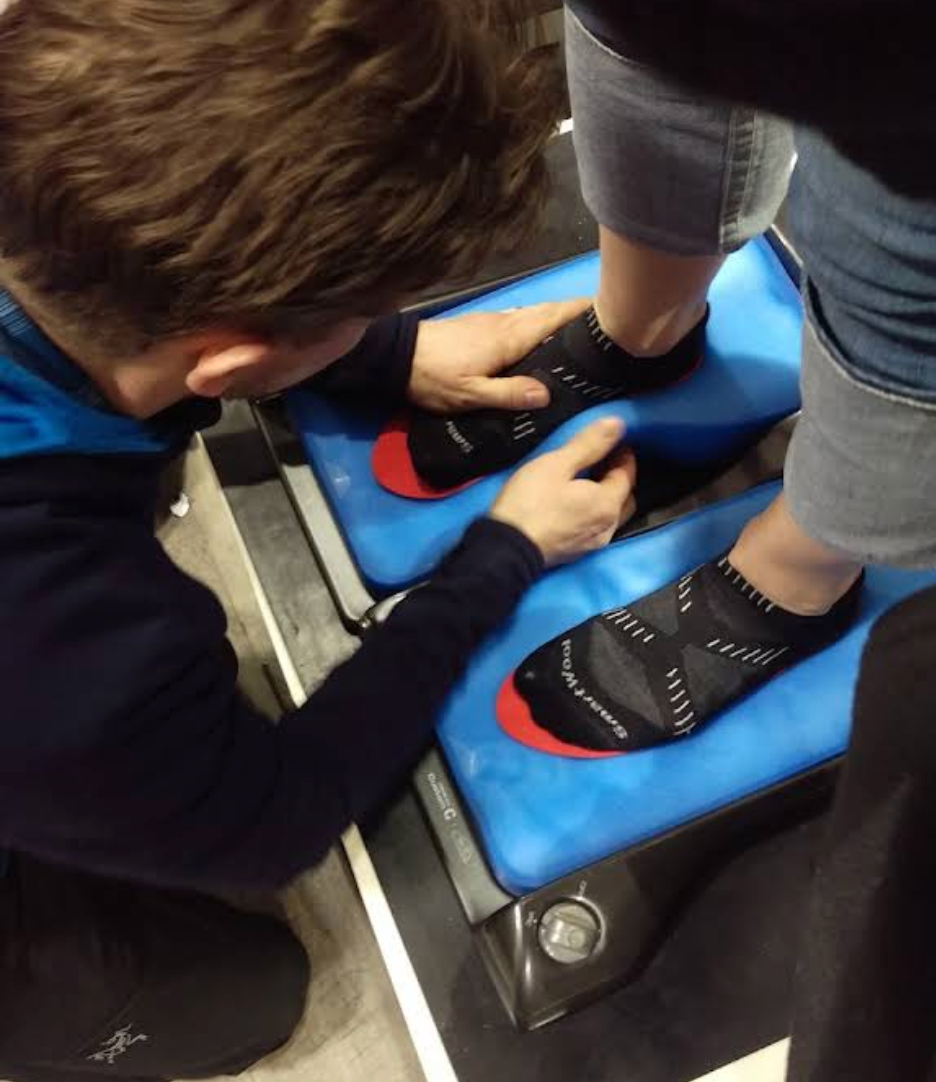
Everything starts with a thorough assessment of your feet. Using the Sidas FEETBOX® EVO scanning system, we capture precise 3D measurements of both feet — length, width, volume, arch shape, and pressure distribution. We also assess your mobility, alignment, and any sensitive areas such as bunions, prominent ankle bones, or previous injury sites. This data forms the foundation of every decision that follows.


Step 2: Selecting the right boot

With a detailed picture of your feet, our fitters identify the boots that best match your foot's dimensions — particularly volume and last shape. We cross-reference this with your skiing ability, style, goals, and flex requirements to narrow down the right options. This step alone is more involved than most skiers expect, and it's why buying boots online without trying them is such a gamble.

Step 3: The right socks

Often overlooked, ski socks are far more important than most skiers realise. They sit in direct contact with your skin and have a direct influence on fit, warmth, and comfort. Our fitters always recommend thin, technical ski socks — dispelling the common myth that warmer feet require thicker socks. In reality, thick socks compress the liner, restrict circulation, and make cold feet worse. A thin, well-made technical ski sock works with the liner rather than against it.


Sold out


Sold out


Sold out


Sold out


Sold out


Sold out


Sold out


Sold out


Sold out


Sold out

Step 4: Custom insoles

The footbed that comes with a standard ski boot is flat, generic, and offers minimal support. It's essentially a placeholder. A custom insole — fitted and trimmed precisely to your boot and foot shape — transforms the foundation your foot sits on. Sidas custom insoles support your arch in its natural position, improve your stance and alignment, distribute pressure evenly across the whole foot, and reduce fatigue over long days on the mountain. For skiers with specific biomechanical needs, more advanced orthotic solutions are also available.


Step 5: Liner customisation

The boot liner is heat moulded precisely to the shape of your foot. This process eliminates pressure points, removes dead space, and creates a snug, enveloping fit that holds your foot in the optimal position throughout the day. The result is a liner that feels like it was made for your foot — because after heat moulding, it essentially has been.

Step 6: Shell modification

This is where the real craftsmanship comes in. The outer plastic shell is reshaped in any areas where your foot requires more space — bunions, prominent bones, wide forefoot, high instep. Using specialist tools, our fitters punch out or stretch specific areas of the shell with surgical precision, creating room exactly where it's needed without compromising the structural integrity or performance of the boot. This is often the step that makes the biggest difference for skiers with challenging or complex feet.

Step 7: Fine-tuning and follow-up

Once all the adjustments are made, your boots are tested and any final tweaks are made. We walk you through the complete fit so you understand exactly how your boots should feel — and if anything needs further attention after your first time on snow, our team is here to help.

Who Are Custom Ski Boots For?

Here's another misconception worth addressing: custom ski boot fitting is not just for experts, racers, or skiers with problem feet. It's for anyone who wants to ski comfortably and perform at their best — which is everyone.

Beginners benefit enormously from a proper custom fit. Learning to ski in boots that hurt or don't support you correctly makes everything harder — balance, confidence, technique. Starting with a great fit from day one sets you up for faster progression and a far more enjoyable introduction to the sport.

Intermediate skiers often find that a custom fit unlocks a level of control and responsiveness they didn't know they were missing. When your boots actually work with your feet, skiing clicks in a way it simply can't when you're compensating for a poor fit.

Advanced and expert skiers need precision. At higher speeds and on more demanding terrain, the quality of your connection to your skis is everything. A custom fit eliminates every source of energy loss and instability, giving you the responsiveness you need to perform at your best.

Skiers with complex or challenging feet — bunions, wide feet, high arches, flat feet, previous injuries, or other conditions — often find that a custom fit is the difference between skiing comfortably and not skiing at all. For this group in particular, professional boot fitting is transformative.

When Should You Get Your Boots Custom Fitted?

The best time is before the season starts — not at the resort on day one of your holiday. Getting your boots fitted in advance means you have time for any follow-up adjustments, time to break the boots in before you hit the mountain, and no queuing at a resort shop when you should be skiing.

If you've already got boots that are causing problems, it's never too late. Many fit issues — pressure points, heel lift, cold feet, poor control — can be resolved through fitting and modification even on existing boots. Come in and see us and we'll assess what can be done.

The Bottom Line

Custom ski boots aren't a luxury reserved for professionals. They're the sensible choice for any skier who wants to get the most out of their time on the mountain — more comfort, more control, less pain, and better skiing from the very first run.

If you've been putting up with uncomfortable boots or suspect your fit isn't quite right, come and visit our expert boot fitters in store. Using the Sidas FEETBOX® EVO and a comprehensive customisation process, we'll transform your boots into something that feels like it was made for your feet — because by the time we're finished, it will be.

Prepare For Your Next Adventure


HIKING


RUNNING


BIKING


SKIING

Leave a comment

Please note: comments must be approved before they are published.