



Understanding Ski Boot Terminology: A Complete Guide for Skiers
Mondo Point
Mondo sizing is the most accurate way to size a ski boot. Rather than relying on UK or US shoe sizes, which vary between brands, mondo point sizing is simply the length of your foot in centimetres. If your foot measures 27cm, you're a mondo 27. It's a consistent starting point before the shell check fine-tunes the fit.
Boot Shell
The hard plastic outer structure of the ski boot, made up of two parts: the lower shell, which houses your foot and heel, and the cuff or upper, which wraps around your lower leg. Shell shape and volume vary significantly between brands, which is why finding the right shell for your foot shape is a critical part of professional ski boot fitting.
Boot Liner
The soft inner boot that sits inside the shell, providing cushioning, warmth, and support. As part of our boot fitting process, we professionally heat mould your liner to conform to the exact shape of your foot, eliminating pressure points and delivering a far more precise fit than an off-the-shelf boot.
Custom Liner
An upgraded liner that creates an even more personalised fit. There are two main types: foam-injected liners, where liquid foam is injected around your foot to create an exact cast, and heat-formable liners moulded using heat and body weight. Our boot fitters will advise whether a custom liner is right for your skiing style and needs.
Boot Last
The internal shape of the boot shell, most commonly discussed in terms of width. A narrow last of around 97 to 98mm suits low-volume feet, a medium last of 100 to 102mm works for average widths, and a wide last of 104mm or more suits broader feet or high insteps. Matching the last to your foot shape is one of the most important decisions in ski boot selection.
Boot Flex
A measure of how stiff or soft the boot is when you push forward into a skiing position. Higher flex means a stiffer, more powerful boot suited to advanced and aggressive skiers. Lower flex means a softer, more forgiving boot better suited to beginner and intermediate skiers. Crucially, the right flex is not just about ability — body weight, leg strength, and skiing style all play a role. Learn more about how tight your ski boots should actually be.
Boot Board
The platform inside the boot shell on which the liner sits, also known by its Italian name, zeppa. Usually removable, it becomes particularly relevant when fitting custom footbeds, as the footbed sits on top of the boot board to provide a more supportive and precisely shaped base.
Custom Footbed
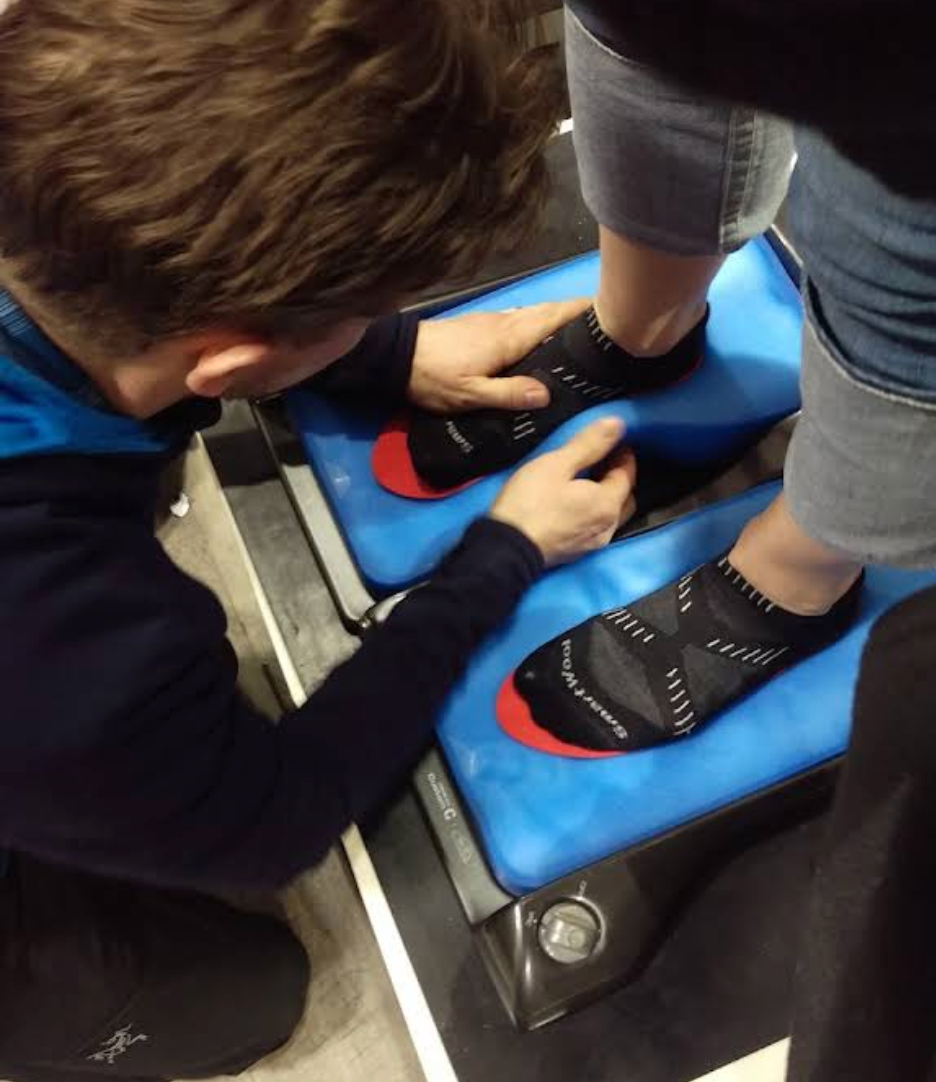
Also called a custom insole or custom ski boot insole, a custom footbed replaces the flat generic insole that comes standard in most ski boots. At Outside Sports we create custom footbeds on-site, taking a carbon copy of your foot using heated thermoplastic insoles set in silicone bags, then reinforcing them with a heel stabiliser suited to your foot type. They improve arch support, correct alignment, distribute pressure evenly, and reduce foot fatigue significantly. We consider them essential to a successful boot fitting, not an optional extra. Learn more about why custom insoles matter.
Cuff Alignment
An adjustment made to the upper cuff of the boot to ensure your lower leg sits correctly inside it. Proper cuff alignment improves your skiing stance, helps your edges engage more efficiently, and reduces unnecessary knee strain. Our boot fitters assess cuff alignment as a standard part of every fitting.
Canting
A lateral adjustment to the boot sole, usually achieved by grinding it at a slight angle, to correct your natural stance and improve your access to all four ski edges. Skiers whose knees naturally fall inward or outward often benefit significantly from canting. We carry out a full alignment and canting assessment as part of every boot fitting at Outside Sports.
Canting vs Cuff Alignment: What's the Difference?
Cuff alignment adjusts the upper boot to match the angle of your lower leg. Canting adjusts the lateral tilt of the entire boot sole to correct your overall stance from the ground up. Both can be relevant depending on your alignment, and in some cases both adjustments are made together.
Shell Modification
Physically altering the plastic boot shell to accommodate the specific shape of your foot. Common modifications include punching or stretching the shell to relieve pressure on bunions, wide feet, prominent ankle bones, or the navicular bone. Shell modifications are completely normal, and ski boot shells are designed to be modified. Our workshop is fully equipped to carry out these adjustments without compromising boot performance or power transfer. Learn more about why you need your boots modified.
Lifter
A layer of plastic added to the underside of the boot sole for extra height or leverage. Lifters are not commonly needed for recreational skiers and are generally reserved for race skiing or specific biomechanical requirements identified during an alignment assessment.
Lugs
The sections of the boot sole that connect with your ski binding. Lugs must meet industry size standards for safe and reliable binding release and can wear down over time if you walk significant distances in your boots. They are usually replaceable, so mention worn lugs during your fitting as it can affect binding performance and safety.
Boot Warmers
Heating elements that can be added to ski boots for skiers who suffer from chronically cold feet. Cold feet in ski boots are often a symptom of a fit issue rather than a temperature problem, so always mention this during your fitting. We'll assess whether improved fit, better ski socks, or boot warmers are the right solution for you.
Still Have Questions?
Understanding ski boot terminology helps you get more from your fitting appointment and make better decisions about your equipment. But the most important thing you can do is come in and talk to us. Our certified boot fitters at Outside Sports are here to guide you through every step of the process, and no question is too basic.
Ready to get fitted? Book your ski boot fitting at Outside Sports and let's find the perfect boot for your feet.